So, youʼve wrapped up your 12th. First of all, congratulations!!! Thatʼs a big step. But now comes the question almost everyone asks: “What do I do next?ˮ
If you're feeling stuck between engineering, medicine, or a standard commerce path, take a breath. Thereʼs another option thatʼs practical, future-ready, and honestly, pretty exciting, Data Science.
We live in a world overflowing with data. From your online shopping habits to every swipe on your phone, it's all being captured. And companies are actively looking for people who can make sense of this chaos. Thatʼs where you come in.
Do you need to be a techie to get into data science?
Not at all. It doesn't matter if you're from Science, Commerce, or Arts. You donʼt need an engineering degree or any prior coding knowledge to begin.
All you really need is:
A curious mind
A willingness to learn and practice
Comfort with school-level math
A growth mindset (yes, that's more important than your board marks)
A lot of professionals in data science today started without any tech background. They just learned consistently, practiced what they learned, and built real projects. And you can too.
In this blog, weʼll walk through everything you need to know what data science really is, the skills required, how to get started after 12th, what kinds of jobs are available, and even how to make your resume and LinkedIn profile stand out.
Not sure if data science is the right fit for your personality and strengths? A psychometric assessment can help clarify if youʼre aligned with the demands of this field.
Is Data Science A Good Career For The Future
Think about the last time Netflix recommended a show you actually liked, or when a food app seemed to know exactly what you were craving. Thatʼs not coincidence thatʼs data science at work. Behind the scenes of every smart suggestion, traffic reroute, or fraud alert is a system making sense of massive amounts of data. Data science is what connects the dots blending code, stats, business understanding, and communication to make smart things happen.
And no! You donʼt need to be a computer genius
If youʼre curious, enjoy solving problems, and like spotting patterns, this field is built for you. You donʼt need years of coding experience. You just need to get started.
Hereʼs the exciting part: thereʼs a growing demand for data professionals and not nearly enough trained people to fill those roles. That gap is your opportunity.
If you've been waiting for the right time to dive in, this is it.
Confused about where to begin? A quick career coaching session can help you choose the right learning path based on your interests.
💡Advanced Pro Tips
You can start learning data science right after 12th, no technical background required
With focused learning, you can be job-ready in about 6 months
Your foundational tools are Python, SQL, and Excel, get comfortable with them
Projects carry more weight than certificates, practical proof matters
A strong resume and LinkedIn profile boost your chances of getting interviews
Salaries grow faster with hands-on experience and consistent learning
This field is beginner-friendly, in demand, and full of possibilities but early action gives you a head start.
Top Data Science Skills For Beginners
Letʼs talk about what you actually need to learn to build a strong foundation in data science.
Start here, the must-have basics:
• Statistics and Excel: These help you interpret and organize data
• Python: The go-to programming language for data work
• SQL: Essential for working with databases
• Data Visualization: Tools like Power BI or Tableau help you present insights clearly
Then level up with:
• Machine Learning: Where your data starts making predictions
• Data Cleaning: Because real-world data is often incomplete or messy
• Projects: The real game-changer, show what youʼve actually done
Donʼt skip these soft skills:
• Problem-Solving: The core of any data job
• Business Thinking: Understand how your analysis drives business decisions
• Storytelling: Learn to explain your insights clearly and confidently
• Start with the basics, and gradually build up. Each new skill adds to your toolkit and moves you closer to being job-ready.
Top Data Science Courses And Certifications For Freshers
Letʼs bust a common myth: landing a data science job isnʼt about collecting certificates—it's about depth, not quantity.
Focus on 2–3 comprehensive programs that:
• Start with foundational concepts
• Emphasize hands-on learning
• Let you build a mini-portfolio recruiters can actually review
A smart learning path might include:
• Python Programming for Data Analysis
• Statistics & Probability for Beginners
• Excel for Data Projects
• SQL & Database Basics
• Data Visualization & Dashboards
• Intro to Machine Learning
• A Capstone Project to tie it all together
When selecting courses, look for:
• Real-world datasets
• Python and SQL practice assignments
• Dashboard-building modules
• Mentor-reviewed mini-projects
Remember: Recruiters care about your ability to solve real problems—not how many certificates are on your resume
Sources: Insights based on top beginner-friendly, structured data science courses from Coursera (e.g., IBM Data Science Professional Certificate, Johns Hopkins Data Science Specialization) coursecorrect.fyiCoursera+1
Credits: Course listings and summaries from Coursera featuring IBM and Johns Hopkins programs
Confused about where to begin? A quick career coaching session can help you choose the right learning path based on your interests.
How Long Does It Take To Learn Data Science?
Wondering how long this whole journey takes? The good news is you donʼt need years. With consistent effort, you can go from absolute beginner to job-ready in about 6 months.
Hereʼs a realistic breakdown most learners follow:
• Month 0–1: Get comfortable with Python, Excel, and data basics
• Month 2–3: Learn how to clean, analyse, and visualize data
• Month 4–5: Start building dashboards and doing mini-projects
• Month 6+: Explore machine learning, polish your portfolio, and prep your resume/LinkedIn
You donʼt have to rush even 1–2 hours a day adds up fast when you stay consistent.
Sources: Based on average learning timelines from learners on Kaggle Learn, freeCodeCamp, and structured self-paced programs as referenced in multiple Reddit & Quora discussions by early-career data professionals (2024–2025).
Now that youʼve got an idea of what data science is and the skills you need, letʼs talk about something thatʼs probably on your mind, “Will I actually get a job after learning all this?ˮ
Short answer? Yes.
And nope, you donʼt need to be a coding wizard or have 5 internships lined up. What you do need is the right skills, a couple of real-world projects, and the confidence to show what you know.
Here are some roles that are totally within reach for beginners:
• Junior Data Analyst – Youʼll work with data, create dashboards, and help teams make sense of numbers. A solid starting point.
• Data Science Intern / Trainee – Learn on the job while getting hands-on with real datasets. Think of this as your training ground.
• Business Intelligence (BI) Intern / Trainee – You'll turn company data into useful business insights.
• Analytics Executive (Marketing / Finance) – You get to analyse customer behaviour or business finances and suggest smart changes.
• Reporting Analyst – Your job? Build regular reports, automate stuff, and help teams track performance.
• Data Visualization Developer – If you enjoy turning data into beautiful, easy-to-read charts and dashboards, this one's for you.
• Research Assistant (AI / Data Projects) – Help out with academic or industry research a great entry point if you like digging deeper.
• ML Assistant – Work on small parts of machine learning projects (even just cleaning data matters!).
• Junior Data Engineer – More on the techie side here, you deal with pipelines and databases.
Most of these roles wonʼt ask you for a computer science degree. They care more about how you think, what youʼve built, and whether youʼre ready to learn on the job.
Honestly, once you get your foot in the door and spend 6–12 months gaining experience, youʼll open the door to higher roles like Data Scientist, ML Engineer, or Analytics Consultant. Everyone starts somewhere this could easily be your “somewhere.ˮ
Need Help Writing A Resume Tailored For These Entry-Level Roles?
Salary Trends In Data Science (India – 2026)
Letʼs talk numbers! Even if you're just starting out, data science roles offer great starting pay compared to most other entry-level jobs.
Hereʼs a general idea for India:
• Freshers (0–1 year): ₹3 to ₹6 LPA
• With 1–2 years of experience: ₹5 to ₹10 LPA
But remember, itʼs not about your degree alone itʼs about what youʼve learned and how well you showcase it. Your projects, problem-solving, and how confidently you present your work during interviews matter a lot more.
Sources: Average salary ranges reported by AmbitionBox, Glassdoor India, and Naukri.com Career Insights.
Top 10 Industries Hiring Data Science Freshers In 2026
Instead of naming only companies, hereʼs a look at the industries where demand for data science freshers is strongest right now:
Instead of naming only companies, hereʼs a look at the industries where demand for data science freshers is strongest right now:
Start here, the must-have basics:
• IT & Consulting – Companies like TCS, Infosys, Accenture continue to hire especially freshers with AI and data-centric skills.
• Global Capability Centers (GCCs) – Global firms like Best Buy are expanding their India tech hubs, especially in data and AI roles.
• IT Services & Digital Engineering – Firms like HCLTech are offering premium pay for freshers with data, AI, and cybersecurity skills.
• IT & Digital Transformation Projects – Capgeminiʼs massive hiring plans signal strong demand for AI-ready freshers.
• Financial Services & FinTech – Rapid adoption of analytics and AI in banking and insurance fuels hiring of data-savvy freshers.
• E-Commerce & Retail Tech – Remains a high-demand sector for data analysts and engineers.
• Healthcare & Pharma Analytics – Accelerating use of AI for diagnostics, research, and operational efficiency.
• EdTech & Online Learning Platforms – Increasing need for analytics to enhance learner experiences and course personalization.
•Automobile & Manufacturing – Adoption of AI and data analytics in R&D, production, and smart mobility solutions.
• Energy & Sustainability – Growing demand for analytics in renewable energy, operational efficiency, and environmental monitoring.
Sources: Industry demand trends based on 2025 hiring announcements, market reports, and recruitment insights.
Credits: Economic Times, Reuters, Times of India, NASSCOM, LinkedIn Jobs Insights 2025.
Resume That Gets You Shortlisted (Data Science Edition)
Letʼs be real, if youʼre trying to break into data science, your resume needs to do more than just list buzzwords. It should show that you're actually applying what you learn, not just collecting certificates. Think of it as your personal proof of work.
Profile Summary - Tell Your Story Fast
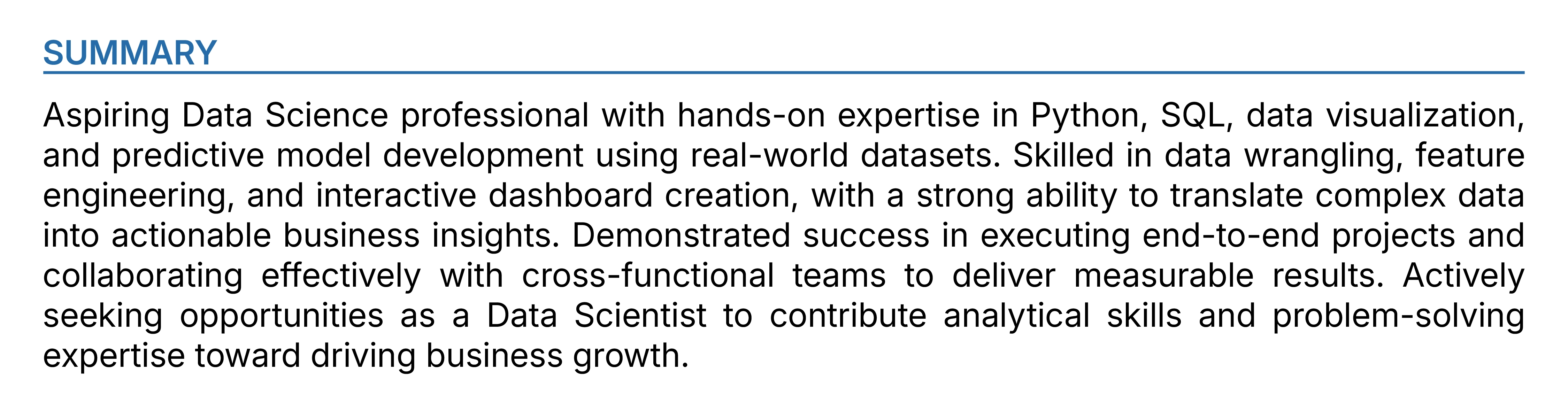
Think of your profile summary as your handshake with a recruiter, short, confident, and memorable. In just 3–4 lines, say who you are, the tools youʼre great with, and the kind of data problems you love solving. Slip in a quick win or project to show you can turn skills into results. And if youʼve got a GitHub, Tableau dashboard, or portfolio? Link it right here nothing grabs attention faster than proof you can deliver.
Skills - Make It Easy To Find You
The skills section is where you need to be strategic. Group your skills under categories like:
• Programming & Tools (e.g. Python, SQL, Excel)
• ML & Analytics (e.g. Regression, Classification, A/B Testing)
• Visualization (e.g. Power BI, Tableau, Matplotlib)
Make sure you include keywords that recruiters or ATS bots might search for. Donʼt overstuff it focus on tools and skills youʼve used at least once in a real project. This is also where your resume and LinkedIn can mirror each other to improve visibility.
Expert help selecting and presenting the right skills for your target role
Work experience - highlight impact, not just duties
Even if youʼre a fresher or just did an internship, your experience section matters. Focus on what you did with data not just the task but the outcome. Use metrics wherever possible. For example, instead of saying “Built a model to predict salesˮ, say “Built a linear regression model that predicted sales with 78% accuracy,improving reporting speed by 30%.ˮ
And yes, link your GitHub repo or dashboard if the project can be shared publicly. Example: GitHub: [Your Project Link] or Power BI: [Dashboard Link] adding links builds trust.
You want to show that your internship was hands-on, results-driven, and collaborative. Something like this:
Turn Your Experience Into Impactful, Results-Driven Bullet Points
Projects - Let Your Work Speak
Your projects section should include 3–4 solid examples that show your range. Each project should explain:
• What the goal was
• What tools or models you used
• The outcome or what insights you got
Projects on real-world datasets (like Netflix viewership or COVID trends) are relatable. Make sure the projects are well-documented. Link them clearly to GitHub, Kaggle, or Tableau. For example: Links: GitHub Repo, Kaggle Notebook, Tableau Public Dashboard.
You donʼt need 10 projects. Just 3–4 quality ones with links that show your thought process and results.
Courses & Certifications – Keep It Relevant
You donʼt have to list every online course youʼve ever done just include the ones that directly support your data science journey. This could be certifications in Python, SQL, Machine Learning, or Power BI. Pick beginner-friendly platforms that offer credible proof of completion (like IBM, Kaggle, or freeCodeCamp).
If your certificate has a public URL, link it. On LinkedIn, add it under the “Licenses & Certificationsˮ section and feature top ones in your “Featuredˮ section. Links: Public Certificate URLs or PDF uploads. Keep this short and skimmable, no need to add course descriptions.
Get your resume professionally written to match ats and data science job standards.
Linkedin profile that gets you noticed (data science edition)
Your LinkedIn profile is not your resume copy-pasted. Itʼs your highlight reel and a live one. Letʼs walk through it.
Linkedin Basics – Look Professional (Even As A Beginner)
Start with a clean, friendly profile photo and use a simple data-themed background banner. Customize your LinkedIn URL to something easy (e.g.linkedin.com/in/yourname).
Your headline (make it pop)
Update your headline to something more specific than just “Student.ˮ Try: “Aspiring Data Scientist | Python · SQL · ML | Passionate about Data-Driven Decisions.ˮ This gives clarity and shows intent.
About Section – Keep It Human
This is your chance to be conversational. Talk about how you got interested in data, what tools you enjoy using, what types of problems you want to solve, and what you're currently working on or learning. If you're open to internships or collaborations, say it here.
Drop in a few links, GitHub, Kaggle, or Tableau dashboards to show you're active and not just collecting certificates. Itʼs okay to sound like a beginner; just be honest and clear.
This should sound like you're talking to a potential teammate, not writing a bio for a newspaper.
Write an ‘aboutʼ section that tells your story and makes you memorable
Featured Section – Use Visual Proof
The Featured section on LinkedIn is like a mini-portfolio. Add links to your best GitHub repositories, dashboards, and any certificates you want people to notice. If youʼve written a blog post, participated in a hackathon, or shared a project write-up this is the place to pin it. Links: GitHub, Tableau Public, Kaggle Notebooks,Certificates.
Recruiters often look at this first before they even scroll so make sure it's up to date.
This part helps people see what you can do in 10 seconds. Pin your best work here:
Experience - (Linkedin Edition) – Keep It Focused
While your resume might have more detail, your LinkedIn Experience section should focus on key actions and impact. Keep it short and bullet-style if needed. You can also use this section to include freelance, internship, or voluntary work involving data.
Again, if thereʼs a relevant project or portfolio item, link it in the description or feature it above.
Same as resume, but keep it slightly tighter. And yes, include links.
Present Your Experience In A Way That Stands Out To Both Recruiters
Education – Go Beyond Just The Degree
Mention your degree, college name, and expected year of graduation. If youʼve taken courses like statistics, Python programming, or data structures list them too.
You can also include academic projects or events where you applied data skills. For example, “Created an ML model as part of final-year project to predict stock trends with 75% accuracy.ˮ
If youʼve participated in coding clubs, analytics competitions, or hackathons definitely mention that. It shows initiative.
Skills Section On Linkedin – Be Strategic
Only add the skills you want to be searched and endorsed for. Recruiters search for profiles using skills like:
• Python
• SQL
• Data Visualization
• Machine Learning
• Data Cleaning
Avoid adding too many random skills. Prioritize the top 10–15 youʼre comfortable with. You can also ask peers to endorse you for key skills, endorsements boost visibility.
Ask friends or project collaborators to endorse your top 3 skills (trust me, it works).
Get Guidance On Picking The Top Skills That Help You Appear In Recruiter Searches
Be Visible – Stay Active
Once your profile is ready, donʼt just set it and forget it. Engage weekly or at least monthly. Share what youʼre learning, talk about your latest project, or post something you built on Tableau or GitHub.
Use hashtags like #DataScience, #MachineLearning, #Python, #OpenToWork to increase visibility. Even small posts like “Just finished my first ML project!ˮ help you get noticed and show youʼre growing.
Want recruiters to find you instead of the other way around? Let us optimize your linkedin profile for visibility.
💡 GOLDEN TIP:
Start posting your learning journey on LinkedIn once a week, whether itʼs a Python trick, a dashboard you built, or a challenge you solved. This builds visibility, confidence, and attracts recruiters even before your first job.
How To Write A Professional Cover Letter For A Data Science Role In 2025
Only add the skills you want to be searched and endorsed for. Recruiters search for profiles using skills like:
(Even If You're a Fresher or Switching Careers)
• Letʼs face it, writing a cover letter can feel awkward.
• “How do I talk about myself without sounding cringey?ˮ
• “Do hiring managers even read cover letters anymore?ˮ
• And the big one: “What do I even say if I donʼt have years of experience?ˮ
•Hereʼs the truth: a well-written cover letter still matters. Itʼs your chance to speak directly to the employer, to show your why, what, and how before they even open your resume.
Whether you're just out of college, shifting from admin to data science, or exploring tech after 12th grade, this blog will walk you through how to write a powerful, professional, and genuinely YOU cover letter that works in 2025.
1 Contact Details: Keep It Clean & Clickable
This partʼs easy, but donʼt overlook it.
Right at the top, add:
• Your full name
• Phone number (no typos, please!)
• Professional email ID (no more cooldude@xyz.com, okay?)
• LinkedIn profile (Make sure itʼs updated!)
• Portfolio or GitHub (if you have one)
2 Introduction: Start Strong (No Boring Stuff Here)
This is where most people lose the reader, donʼt be one of them. Your intro needs to tell a quick story:
• Who are you?
• What are you applying for?
• Why this role, why this company?
3. Body: Show Your Journey, Not Just Skills
This is where the magic happens. Hiring managers arenʼt looking for a list of tools they want to know how youʼve used them.
No Real-World Experience Yet? Use Project Outcomes Instead. Get A Professionally Written Cover Letter Tailored To You
4. Conclusion: Wrap It Up Like A Pro
This is where the magic happens. Hiring managers arenʼt looking for a list of tools they want to know how youʼve used them.
5. Express Gratitude Naturally
Not Confident Your Closing Sounds Employer-Ready? Get Expert Feedback From Professionals.
Key Takeaways – COVER LETTER
• Your cover letter = your voice before the interview.
• Tell your why clearly especially if you're new or switching fields.
• Use real examples, even small ones. Projects, coursework, and internships count.
• Show future direction, companies love to hire learners.
• A good cover letter complements your resume, not repeats it.
Quick Checklist Before Sending
• Is the letter 100% tailored to the role and company?
• Did I use real stories and metrics, not vague statements?
• Is it one page max, well-spaced, and cleanly formatted?
• Did I include all contact links clearly?
• If yes? Hit send with confidence.
If youʼre unsure whether your current cover letter is doing you justice, Career Desire can help. From resume building to LinkedIn makeovers to interview prep we guide you every step of the way.
▪ Donʼt miss your chance to stand out.
▪ Donʼt send another generic application.
Want An Expert To Review Your Entire Application Package (Resume + Cover Letter + Linkedin)?
Common Interview Questions (Data Science Edition)
• Tell me about yourself?
• Why should we hire you?
• What are your goals?
• Where do you see yourself in next 5 years?
• What is your salary expectation?
• What are your weaknesses?
• What are your strengths?
• Why did you leave your previous job/why are you leaving your current company?
Technical Interview Questions
• Explain the difference between supervised and unsupervised learning.
• What is overfitting and underfitting, and how do you address them?
• Can you explain the bias-variance trade-off?
• Describe a machine learning project you have worked on.
• What is the difference between L1 and L2 regularization?
• How do you evaluate the performance of a machine learning model?
• Explain the concept of cross-validation.
• What is a confusion matrix, and how is it used?
• How do you choose the right model for a dataset?
• What is p-value and how do you interpret it?
• How do you handle imbalanced datasets?
• Explain the difference between NumPy and Pandas.
• How would you optimize the performance of your Python code?
• What are different ways to handle missing values in a dataset?
• How do you choose the right evaluation metric for a classification problem?
• What is the difference between precision, recall, and F1-score?
• Explain the architecture of a Convolutional Neural Network (CNN).
• What is backpropagation?
• How do you handle vanishing gradient problem?
Technical Interview Questions
• Walk me through a recent project what was the problem, your approach, and outcome?
• What challenges did you face while cleaning or modelling the data?
• How did you evaluate and improve your model?
Modern Tool & Workflow Questions
• How do you track model experiments?
• Have you used tools like ML flow, DVC, Airflow, or Docker?
• Whatʼs your process for deploying a model to production?
GenAI/LLM Awareness
• Have you explored prompt engineering?
• What do you know about transformers and how they work?
• How would you fine-tune a pre-trained model like BERT or GPT?
Feeling Nervous About Interviews? Practice With Our Interview Preparation Support Designed For Freshers.
Avoid These Common Beginner Mistakes
Starting your data science journey? Great but donʼt fall into these common traps:
• Only watching tutorials without applying what you learn
• Taking too many courses but building zero real projects
• Waiting to feel “perfectly readyˮ before applying for jobs
• Ignoring your resume and LinkedIn profile
• Thinking a degree is the only way to get hired
• Trying to learn everything instead of mastering key tools
• Underestimating soft skills like communication and teamwork
• Avoiding feedback or being afraid to make mistakes
Feeling Nervous About Interviews? Practice With Our Interview Preparation Support Designed For Freshers.
Conclusion: Ready To Launch Your Career With The Right Tools?
Data Science isnʼt just another course itʼs the language of the future. Companies today are investing heavily in data-driven decisions, and roles are opening up across industries like finance, healthcare, e-commerce, and AI research.
If youʼre stepping into this field, hereʼs what will set you apart:
• Strong command of Python, SQL, R, and statistics
• Practical exposure to machine learning and AI applications
• The ability to create compelling data visualizations and dashboards
• Problem-solving through real-world case studies and projects
• Awareness of industry trends like automation, cloud computing, and big data expansion
But mastering the course alone isnʼt enough your presentation matters just as much as your preparation. Recruiters want to see clarity, confidence, and career direction in every application.
Thatʼs where Career Desire comes in. We keep it simple, powerful, and effective with:
• ATS-friendly Cover Letters & Resumes
• Personalized Career Coaching
• Psychometric Insights for role alignment
• LinkedIn Optimization
• Interview Prep that boosts confidence
Youʼve explored the skills, scope, and path ahead now donʼt stop at learning. Launch your data science career with the right tools and guidance today.